The NQ's US session: 3:30 pm to 10 pm
A thin book at 0.25 point: NQ depth against the ES
The central fact of this course fits in one sentence: the NQ is a big contract on a thin book. Everything else, the invisible icebergs, the cheap stop runs, the slippage, the way to read a wall, follows from it.
Two contracts of comparable weight
| NQ | ES | |
|---|---|---|
| Multiplier | $20 per point | $50 per point |
| Tick | 0.25 point, $5 | 0.25 point, $12.50 |
| Index (order of magnitude, October 2026) | 24,500 | 6,900 |
| Notional of one contract | about $490,000 | about $345,000 |
| Range of an ordinary day | 1.2 to 1.8%, i.e. 300 to 450 points | 0.7 to 1.1%, i.e. 50 to 75 points |
| Ticks travelled in an ordinary day | 1,200 to 1,800 | 200 to 300 |
Read the last line twice. For a slightly higher percentage range, the NQ crosses five to six times more price levels than the ES. The liquidity market makers agree to post must therefore spread over many more prices, for a bigger notional per contract.
What that gives in the book
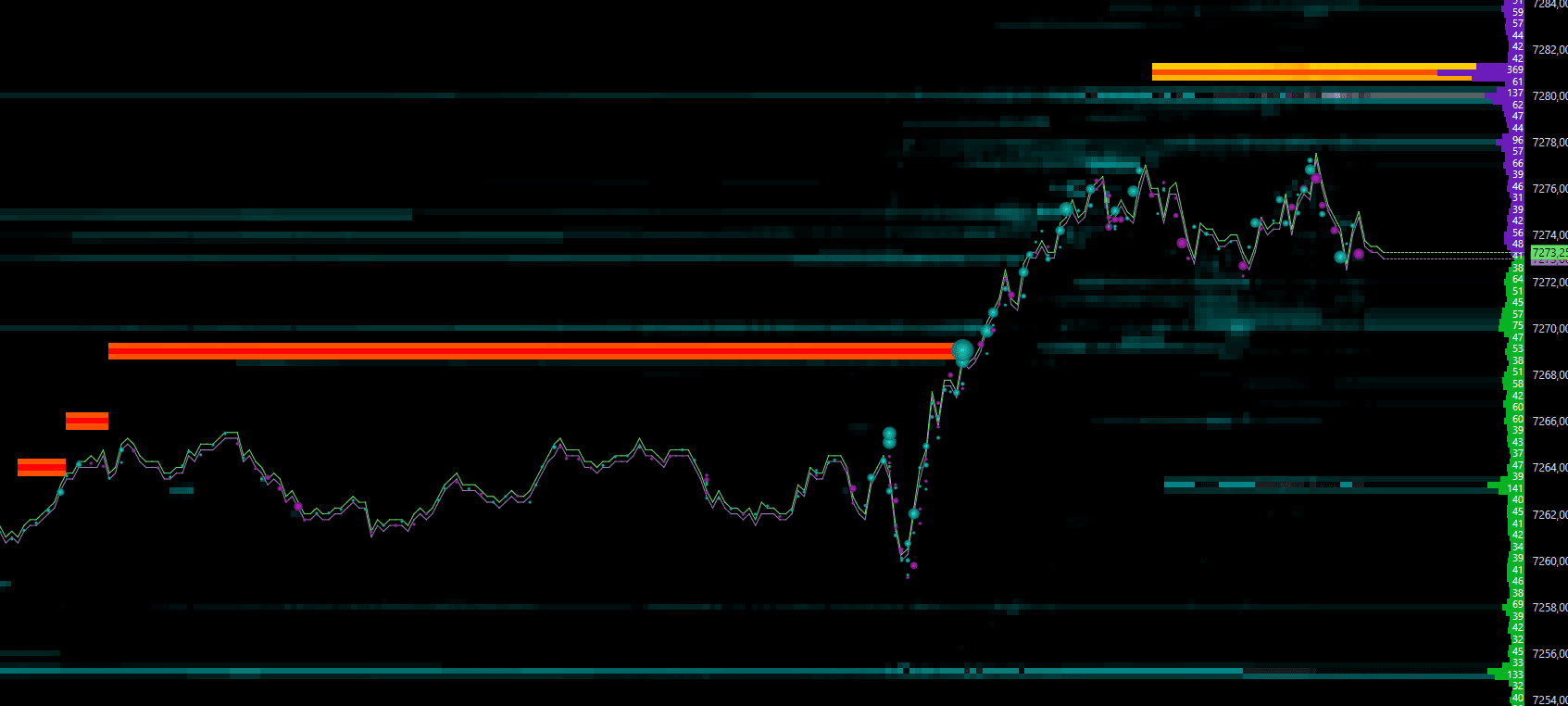
On the ES, an ordinary session shows several hundred contracts on each of the first ten levels, sometimes thousands. On the NQ, the same ten levels often show a few dozen contracts each, and a level at 150 or 200 contracts is already a wall the heatmap colours hot.
Same screen height, same number of levels: twenty book rows cover five points on both contracts, but the ES stacks ten times more contracts in them. A 150-lot wall on the NQ weighs as much, in proportion, as a 1,500-lot wall on the ES.
Four consequences, all used later in the course:
- Walls are small in absolute value and big in proportion. The threshold of what counts as a wall is not a fixed number: it is a multiple of the average depth of the moment. DeepDom does it for you with its relative colour scale; never replace it with a hard threshold copied from an ES course.
- A 30-contract market order crosses several levels. The same order on the ES does not move price. That is what makes the NQ footprint so expressive: each aggression leaves a readable trace on two or three prices.
- A stop run costs little to organise. Triggering the stops stacked below an obvious low takes a few dozen contracts, not a few hundred. Sweeps are therefore more frequent and shorter than on the ES, and card 1 of module 5 is built on them.
- Slippage is a fact of the trade. A protective stop executed two to four ticks beyond the trigger is normal on the NQ in an ordinary session; ten ticks on a macro number. Module 6 measures and budgets it.
The book breathes with the hour
Depth is not a constant of the day. On the NQ, it rebuilds between 3:30 and 3:45 pm, peaks between 4 pm and 5:30 pm, empties during the American lull, partly returns after 7:30 pm and transforms in the last quarter hour, when the contracts shown are no longer looking for the same price as you (module 2). The same 120-contract size is a wall at 6 pm and an ordinary row at 4:15 pm.
End of the free lesson
The other 23 lessons of this course, its quizzes and the completion certificate open with the Student role.
It's free: join the Discord, click the Student role, then log in with Discord here to access all courses.
→ What CME MBO shows on the NQ